Showing posts with label 2nd Grade. Show all posts

Erasers as Music Manipulatives

Mini erasers can be a valuable manipulative in the music classroom.  Use them for rhythm activities, pitch work and workstations.  Learn more and start collecting!

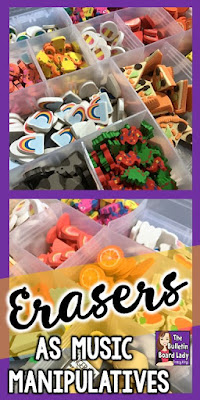
My 5 year old daughter is a collector.  Okay, she is probably a future hoarder.  She loves putting things in her "collections" and one of those treasures is erasers.  She loves those colorful, unique erasers not so much for erasing but for pretend play, counting and more.  This gave me a great idea for music class!
Mini erasers can be a valuable manipulative in the music classroom.  Use them for rhythm activities, pitch work and workstations.  Learn more and start collecting!
I decided to use the 16 block grid as a means for students to create and organize rhythm patterns based on the erasers.  I talk a little bit more about the grid and the lap packs they are used with in THIS blog post.

Mini erasers can be a valuable manipulative in the music classroom.  Use them for rhythm activities, pitch work and workstations.  Learn more and start collecting!
At this workstation, students choose an erase and put it in a square.  Then, students decide what to call the eraser.  They can be creative with this part (and often are!).  When they decide what to call the eraser they write the name under it.  In this picture they actually put it in the second row, but usually we put it in the same box as the eraser.

Mini erasers can be a valuable manipulative in the music classroom.  Use them for rhythm activities, pitch work and workstations.  Learn more and start collecting!
Students can be creative in naming the erasers depending on the rhythms they know or want to use.  For example watermelon could be called "fruit".  Pizza could be "slice" or "piece of pizza" or "veggie pizza".  This works are a means of differentiation.  Students can make this as difficult or as easy as they like.

After they have created the rhythms, they share them with their group.  I use this activity as part of a workstation rotation so there are 3-5 kids in a group.  Students can then choose body percussion or a small percussion instrument to perform their rhythm as an ostinato in their group.

This would also work as a whole group activity.  You could write the rhythms on the board or use a document camera, erasers and grids to replicate student compositions.  Then you could create ostinatos using percussion instruments, Orff instruments or body percussion to create a really fantastic piece.


Mini erasers can be a valuable manipulative in the music classroom.  Use them for rhythm activities, pitch work and workstations.  Learn more and start collecting!
I've found erasers in many different stores:  Target (Dollar Spot), Office Max, Five Below, Dollar Tree and more.  I'm storing them in a box that was designed for beads right now, but I think that I might try this organizer (from Michael's) as my collection grows. (Pictured below.)
Mini erasers can be a valuable manipulative in the music classroom.  Use them for rhythm activities, pitch work and workstations.  Learn more and start collecting!
 In addition to using the erasers for rhythm practice you could also use them with a staff and do melodic dictation using the erasers as note heads.  This would be particularly fun if you had erasers to match the theme of a song.  For example, fish while listening to "Aquarium" from Carnival of the Animals or Jack-o-lanterns while listening to "Night on Bald Mountain would be fun to create an activity around.

I hope that you have been inspired to try mini erasers in your classroom.  I also hope that I haven't created an addiction for you!  I have already started collecting erasers for Halloween, Christmas and Easter!

Like these ideas?  PIN THEM for later!
Mini erasers can be a valuable manipulative in the music classroom.  Use them for rhythm activities, pitch work and workstations.  Learn more and start collecting!


post signature

Teaching the "KNACK" of Note Reading

Learn a fun manipulative for teaching rhythm called Note Knacks.  Use them as a whole class visual aid, in small groups or workstations.  So much fun!

I am always on the look out for manipulatives that keep students engaged.  If you are a regular reader of my blog you know that I am also found of manipulatives that work well as part of workstation rotations.  In this blog post I am going to talk about the awesome blocks called Note Knacks.  (This is not a sponsored post, I just LOVE these!)
Learn a fun manipulative for teaching rhythm called Note Knacks.  Use them as a whole class visual aid, in small groups or workstations.  So much fun!

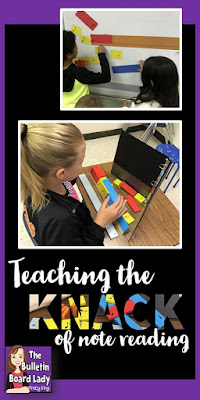
Note Knacks are wooden blocks that are strategically cut so that note value is represented by block length.  So a half note is half the size of a whole note and a quarter note is half the size of a half note and so on.  The set comes with 3 different frames to hold the Note Knacks.  They measure 4 beats, 3 beats and 2 beats.  One side of the block has a note and the back side has the corresponding rest.  
Learn a fun manipulative for teaching rhythm called Note Knacks.  Use them as a whole class visual aid, in small groups or workstations.  So much fun!

I am lucky enough to have a magnetic set of Note Knacks and I keep them on my dry erase board.  They are much larger so that they can be seen by an entire classroom.  I've used them to decipher rhythms in familiar songs and to create ostinatos for various activities.  I've also used them in workstations.

Learn a fun manipulative for teaching rhythm called Note Knacks.  Use them as a whole class visual aid, in small groups or workstations.  So much fun!

For the workstation, I had one student sit at a desk with the wooden blocks.  We put up an empty notebook to create a privacy screen.  The student at the desk composes a rhythm and then claps it for the rest of the group.  The other group members re-create the rhythm using the magnetic blocks on the board.  Students LOVED using the blocks.

I must admit that I like using them too!  There is something lovely about they way they feel and being a visual learning, I totally dig the visual representation of duration.
Learn a fun manipulative for teaching rhythm called Note Knacks.  Use them as a whole class visual aid, in small groups or workstations.  So much fun!
I've also had students trace the outline of the blocks on long strips of bulletin board paper.  I only have one set of the blocks, so I could only do this activity with small groups as they rotated through workstations.  I hope to get a few more sets because I have SO many ideas I want to try out!

I bet I know what you are thinking.  Couldn't you just make something similar?  Well, sure.  I've made Noodle Notes which are similar.  The tactile experience of Note Knacks is what I like.  I mean, who doesn't like playing with blocks?

You can get Note Knacks from Rhythm Band Instruments.  If you liked these ideas PIN this post for later!
Learn a fun manipulative for teaching rhythm called Note Knacks.  Use them as a whole class visual aid, in small groups or workstations.  So much fun!

post signature

Music Lesson Ideas for Quiet Days

Music lesson plans for days when you need to be as quiet as possible.  These quiet activities include ways to teach pitch, rhythm, composers and more in a quiet music classroom.

"You want me to teach music QUIETLY?" I said in disbelief.  "Is that even possible?"

It was testing season and I was fortunate to have my schedule only moderately rearranged.  The problem?  I had to teach music as quietly as possible.  I laugh thinking about how dumbfounded I was at the very idea.  Now with quite a few testing seasons under my belt I have a few suggestions for how to teach musical lesson in quiet ways.  Read on, but shhhh! Let's keep it down.

Pitch

Music lesson plans for days when you need to be as quiet as possible.  These quiet activities include ways to teach pitch, rhythm, composers and more in a quiet music classroom.
One of my favorite quiet activities for teaching pitch is to use my bottle cap staff sheets.  I have them laminated and use them for a variety of lesson.  For this lesson I pass out the sheets and a hand full of bottle caps.  I will say a word that can be spelled on the staff and students "write" it by putting their bottle caps in order.  In the picture, we just spelled "cafe".
Although the staff sheets are easy enough to make, I have a whole set of the staves and word cards in my store that you maybe interested in:  Bottle Cap Staff

 Rhythm

Music lesson plans for days when you need to be as quiet as possible.  These quiet activities include ways to teach pitch, rhythm, composers and more in a quiet music classroom.
 There are many ways to work on rhythm quietly.  Consider using chopsticks instead of rhythm sticks to play on the back of chairs or even on the floor.  The sound is light and intriguing for even 6th graders.
Another great quiet drumming activity (I know...quiet drumming?) is to use drum sticks on  foam garden kneeling pads.  I found purple and blue ones at Dollar Tree and LOVE that kids can really beat on them, but they sound delightfully muted.  :-)
Music lesson plans for days when you need to be as quiet as possible.  These quiet activities include ways to teach pitch, rhythm, composers and more in a quiet music classroom.

Rhythmic dictation is a pretty quiet activity too.  I use dry erase boards or lap packs (staff paper or blank paper stuffed into a page protector) and dry erase markers.  You might consider using craft sticks, rhythm cards, mini erasers (matching the syllables in the name of the eraser to the number of sounds in the rhythm) and more.  Clap or tap the rhythms on an instrument, students echo and then write it down.  It is a great assessment and requires great listening skills.

Instead of writing the rhythms down, you might consider having students listen to the rhythm that you play and then circling the correct notation from a few examples.  I have an entire set of "What Do You Hear" worksheets that ask students to do just that.  They vary in complexity so you can use the set with multiple grade levels.  Click HERE to learn more.
Music lesson plans for days when you need to be as quiet as possible.  These quiet activities include ways to teach pitch, rhythm, composers and more in a quiet music classroom.

 Composer Studies

Music lesson plans for days when you need to be as quiet as possible.  These quiet activities include ways to teach pitch, rhythm, composers and more in a quiet music classroom.
If you are able to show videos, I highly recommend the Composer Series of movies about the lives of famous composers.  (not an affiliate link)  You probably already have these in your classroom.  

In addition to showing composer videos, you might consider planning time for your students to just listen to, read about and color pictures of popular composers.  I've talked about this kind of thing in a previous blog post: Coloring Composers.  You can get the set that I use HERE.

I also LOVE Jena Hudson's composer flip books.  You can find them in her store, Sew Much Music on TpT, or follow this link to try the American Composers Set for free!  

 Listening

Music lesson plans for days when you need to be as quiet as possible.  These quiet activities include ways to teach pitch, rhythm, composers and more in a quiet music classroom.

Another quiet, creative activity is listening and responding.  Choose a piece of music that inspires a story or vivid mental images.  Have students listen the first time.  For wiggly classes you may want to have them lightly tap the beat or follow you as you tap the beat in various ways.  
Next, have students lie down (if possible), close their eyes and imagine what kind of story the composer wanted them to "see" in the music.
Pass out blank pieces of paper and have them illustrate what they have heard.  For K-2, I often use THIS set of writing prompts that already have a few words written and blank writing lines.

A few of my favorite pieces to use are:
"Moonlight Sonata" by Beethoven (Be prepared!  This one sometimes brings pictures of pets that have passed away!)
"Bugler's Holiday" by Anderson
"Stars and Stripes Forever" by Sousa (Shh! You might want to turn this one down a little!)
"Ballet of the Unhatched Chicks" by Mussorgsky
"Funeral March of a Marionette" by Gounod
"Minute Waltz" by Chopin
"Hungarian Dance No. 5" by Brahms

 Instruments of the Orchestra


If you are able to show videos, I highly recommend the Instrumental Classmates set of videos to introduce the instrument families.  I found my set on Amazon.  Quaver also has a great series of videos about instruments that your students will enjoy.  

If you are unable to show a video, your students might enjoy putting together a book of instruments.  Students can color the instruments, copy their name or add information about the instrument (with the add-on sheets included).  Click the picture above to get the full set of instrument families or click HERE to get the sampler for free.  Although this takes some time to make all of the copies you'll need, it is a great activity for a quiet day in music.

Another great quiet day activity is to read the book "The Remarkable Farkle McBride".  My 5th graders enjoy this story, so I can use this lesson with all of my classes.  At the end of the story, we will review instrument families and I'll pass out these simple coloring sheets.  While students are coloring we will listen to my classical music playlist for some quiet background music.

 Quiet Games

Music lesson plans for days when you need to be as quiet as possible.  These quiet activities include ways to teach pitch, rhythm, composers and more in a quiet music classroom.
Quiet games are not usually favorites in my classroom, but over the years I've come up with a few that students will give a reluctant thumbs up.  They would much rather be drumming and dancing and singing, but quiet days don't always allow for that.

Telephone - This traditional game is played by having students sit in a circle and whispering a message to each other until it makes it all the way around the circle.  Hilarity ensues when the message at the end sounds nothing like the message that started.  The same idea can work with rhythms.  Have students tap a 4 beat measure on the back of the person next to them and then pass that around the group.  Students can usually master this in a couple of tries so then we make it a bit more difficult.  Instead of sending one rhythm around in one direction, start two rhythms.  One goes to the left and the other to the right and they all end up back at the same person.  Tricky!

Roll and Cover is a game for small groups.  Students take turns rolling the dice.  The key on each page says a note or rest name.  Students then find that symbol in the picture and color one piece of the picture.  Taking turns, play goes around the circle until someone has every piece colored.  It is a nice way to review notes and clefs.  You can find Roll and Cover sets in my store.  Any normal die will work, but I always try to get the large foam dice to use because they are so much more fun!

I hope that you are never asked to teach music quietly, but if you are I hope that some of these ideas will prove helpful.  Like these ideas?  PIN THEM for later.

Music lesson plans for days when you need to be as quiet as possible.  These quiet activities include ways to teach pitch, rhythm, composers and more in a quiet music classroom. 


post signature

Rhythm Go Rounds

Great ideas for using Music-Go-Rounds to teach rhythm.  Use them in centers, to decode song notation, with body percussion and more!

I have really been having a great time with the Music-Go-Rounds that I received from Music in Motion.  In a previous blog post, I talked about how I used them with vocal activities.  You can read about those activities HERE.  In this post I want to share with you some of the ways I have used them to teach rhythm.  Although these manipulatives are called Music-Go-Rounds, I borrowed the name "Rhythm Go Rounds" from a clever student that dubbed them as such.

Great ideas for using Music-Go-Rounds to teach rhythm.  Use them in centers, to decode song notation, with body percussion and more!

As I mentioned in my previous post, Music-Go-Rounds are thin, silicone circles that cling to a variety of surfaces.  They are so much fun to touch!  While working at some of these rhythm stations I had to continually get on to kids that loved playing with them.  I found one student that had folded them and placed them between each of his fingers.  I scolded him, but not until after laughing at him.  I could completely relate!

At this station, I introduced students to the duration relationship between the whole note, half note, quarter note and barred eighth notes by setting the Music-Go-Rounds up in this order.  We clapped through the patterns together and then I left them to create their own patterns.  In the photo below, you can see one of their examples.  This activity gave me the opportunity to work with students in small groups and to differentiate if needed.  This is a cabinet door in my classroom.  It has a smooth surface the the Music-Go-Rounds cling to it nicely.

Great ideas for using Music-Go-Rounds to teach rhythm.  Use them in centers, to decode song notation, with body percussion and more!

Great ideas for using Music-Go-Rounds to teach rhythm.  Use them in centers, to decode song notation, with body percussion and more!
This is another example from a group that only sort of paid attention.  I appreciate that they were sorting correctly though!


Great ideas for using Music-Go-Rounds to teach rhythm.  Use them in centers, to decode song notation, with body percussion and more!
In another activity, we used the Music-Go-Rounds to match the syllables of words with rhythm that could represent it.  After singing "Ode to Composers" from Music K-8 magazine, I thought I would use composer names for this closing activity of the lesson. 

Great ideas for using Music-Go-Rounds to teach rhythm.  Use them in centers, to decode song notation, with body percussion and more!
I do several different activities with body percussion from Kindergarten through 6th grade.  Students love to take the opportunity to create with body percussion.  I use the activities in THIS set from my store for composing with body percussion for lower elementary.  For upper elementary, we often transfer our patterns to a body percussion staff.
Great ideas for using Music-Go-Rounds to teach rhythm.  Use them in centers, to decode song notation, with body percussion and more!
I used masking tape to create this staff on a dry erase board.  I labelled the staff with "stomp", "pat", "clap" and "snap".  Students arranged rhythms for their small group and the group performed them.  They had such a great time that they didn't realize how much they were reading and performing rhythms.  Teacher win!

There are probably many other ways to do this, but I prefer using the Music-Go-Rounds over dry erase markers.  For some reason, I always have kids that draw on themselves with them.  That makes me crazy.  The Music-Go-Rounds are also such a novel way to keep students engaged too.
Great ideas for using Music-Go-Rounds to teach rhythm.  Use them in centers, to decode song notation, with body percussion and more!
After the small groups had a chance to experiment with this station, we created some patterns as a class.  We took turns performing each line, performing them all together and even reading the vertically!  

I hope this post has given you a few new ideas for teaching rhythm.  If you like these ideas PIN THEM for later. 

Great ideas for using Music-Go-Rounds to teach rhythm.  Use them in centers, to decode song notation, with body percussion and more!


post signature

Instruments of the Orchestra Workstations

Instruments of the Orchestra Workstations can be the perfect addition to your student of instruments and instrument families.  Learn about a few easy centers to implement into your classroom and woo your students to success.

My third graders due a huge unit on instruments of the orchestra.  In Kindergarten through Second grades we discuss instruments as they come up in pieces we are listening too.  We spend time learning to identify classroom percussion instruments and classify them.  Third grade we really hit it hard and work to learn instrument names, their correct spelling, instrument families and how to identify them aurally.

This year I chose Instruments of the Orchestra as the content for the SLOs that I am recording.  SLOs are student learning objectives.  We are required to pretest and post-test and record the data for analysis.  After spending a week on each instrument family, my students work in centers to review and prepare for their test at the end of the unit.  Here are the workstations they completed.

Clip It-Instruments


Instruments of the Orchestra Workstations can be the perfect addition to your student of instruments and instrument families.  Learn about a few easy centers to implement into your classroom and woo your students to success.

Instruments of the Orchestra Workstations can be the perfect addition to your student of instruments and instrument families.  Learn about a few easy centers to implement into your classroom and woo your students to success.

At this station, students review instruments and their names as they determine how many syllables are in each instrument name.  Then they take a clothespin and pin the note or rhythm that most closely matches the syllable of the instrument.  This is mostly rhythm work, but this is an opportunity for students to see a picture of the instrument and the instrument name.  You can get this Instrument Clip It here.

Instrument Dabbers

Instruments of the Orchestra Workstations can be the perfect addition to your student of instruments and instrument families.  Learn about a few easy centers to implement into your classroom and woo your students to success.


I think that I may love dabbers more than my students!  I am always looking for ways to incorporate them into center time.  At this station students had four worksheets to complete (one for each instrument family).  Students dabbed instruments belonging in each family.  So fun!  You can get this dabber set HERE.

Instruments of the Orchestra Workstations can be the perfect addition to your student of instruments and instrument families.  Learn about a few easy centers to implement into your classroom and woo your students to success.Instruments of the Orchestra Workstations can be the perfect addition to your student of instruments and instrument families.  Learn about a few easy centers to implement into your classroom and woo your students to success.

Some of the dabber pages needed a little bit of time to dry.  We laid them on our seats and by the time most students had rotated through all of the stations, their papers were dry and ready to go home to hang on the fridge.
Instruments of the Orchestra Workstations can be the perfect addition to your student of instruments and instrument families.  Learn about a few easy centers to implement into your classroom and woo your students to success.

Instrument Guess Who

Instruments of the Orchestra Workstations can be the perfect addition to your student of instruments and instrument families.  Learn about a few easy centers to implement into your classroom and woo your students to success.
This fun workstation was created by Chrissy at Hutzel's House of Music.  You need to purchase the regular Guess Who game and then purchase her insert, trim it and slide it into the case.  Students compete against each other to figure out a selected instruments.  They can only ask yes and no questions.  Here's a few of the GREAT thinking and learning questions I heard from this workstation;
"Is it a member of the brass family?"
"Does it use a reed?"
"Do you scrape it to make a sound?"
"Is it bigger than my arm?"
How awesome is that?  I love that this center allows them to really think about what each instrument looks like and helps them come up with ways to describe their characteristics.


 Instrument Family Punch Cards

 Instruments of the Orchestra Workstations can be the perfect addition to your student of instruments and instrument families.  Learn about a few easy centers to implement into your classroom and woo your students to success.

Instruments of the Orchestra Workstations can be the perfect addition to your student of instruments and instrument families.  Learn about a few easy centers to implement into your classroom and woo your students to success.

This station is SO much fun!  I have a collection of hole punches.  Some have stars, hearts, music notes or the original circle.  At this center, students complete four punch cards (one for each family).  On each card they are asked to punch the instruments for a specific family.  You can download the cards HERE.

In my classroom, this station worked out best to be a standing station.  I used an empty cart and placed supplies on it.  Students stood around the cart to complete their center work.  Most students really enjoyed this opportunity to stretch their legs.  I will definitely add more standing stations in the future.

Instruments of the Orchestra Workstations can be the perfect addition to your student of instruments and instrument families.  Learn about a few easy centers to implement into your classroom and woo your students to success.  Instruments of the Orchestra Workstations can be the perfect addition to your student of instruments and instrument families.  Learn about a few easy centers to implement into your classroom and woo your students to success.

  Rap It, Clap It, Music Match It

Instruments of the Orchestra Workstations can be the perfect addition to your student of instruments and instrument families.  Learn about a few easy centers to implement into your classroom and woo your students to success.
 Similar to Instrument Clip It, the instrumental version of Rap It, Clap It, Music Match It asks students to sort instruments by the number of syllables in their name.  You can grab this set HERE.
Instruments of the Orchestra Workstations can be the perfect addition to your student of instruments and instrument families.  Learn about a few easy centers to implement into your classroom and woo your students to success.

Reading Station

Instruments of the Orchestra Workstations can be the perfect addition to your student of instruments and instrument families.  Learn about a few easy centers to implement into your classroom and woo your students to success.

 I always like to include a reading station if time and space allow.  At this station students sat on the carpet and read books.  I really wanted to include only books about instruments, but just don't feel like I have enough in my library yet.  I included books about composers and a few seasonal books too.

Other Instrument Workstations
There are many great instrument workstations that I could have used for this activity, but had to narrow them down based on the number of students in each class and our limited time together.  You might enjoy reading about Instrument Family Dip and Chip Tray Workstations from a previous blog post or click through some of these ideas:

Mystery Instruments  A brown paper bag, a classroom instrument and a detective sheet.
Instruments of the Orchestra Workstations can be the perfect addition to your student of instruments and instrument families.  Learn about a few easy centers to implement into your classroom and woo your students to success.


post signature