Showing posts with label beat and rhythm. Show all posts

Erasers as Music Manipulatives

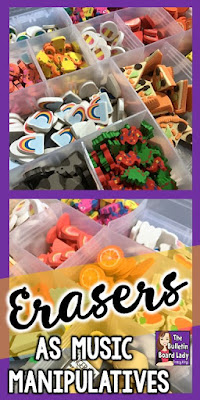
Mini erasers can be a valuable manipulative in the music classroom.  Use them for rhythm activities, pitch work and workstations.  Learn more and start collecting!

My 5 year old daughter is a collector.  Okay, she is probably a future hoarder.  She loves putting things in her "collections" and one of those treasures is erasers.  She loves those colorful, unique erasers not so much for erasing but for pretend play, counting and more.  This gave me a great idea for music class!
Mini erasers can be a valuable manipulative in the music classroom.  Use them for rhythm activities, pitch work and workstations.  Learn more and start collecting!
I decided to use the 16 block grid as a means for students to create and organize rhythm patterns based on the erasers.  I talk a little bit more about the grid and the lap packs they are used with in THIS blog post.

Mini erasers can be a valuable manipulative in the music classroom.  Use them for rhythm activities, pitch work and workstations.  Learn more and start collecting!
At this workstation, students choose an erase and put it in a square.  Then, students decide what to call the eraser.  They can be creative with this part (and often are!).  When they decide what to call the eraser they write the name under it.  In this picture they actually put it in the second row, but usually we put it in the same box as the eraser.

Mini erasers can be a valuable manipulative in the music classroom.  Use them for rhythm activities, pitch work and workstations.  Learn more and start collecting!
Students can be creative in naming the erasers depending on the rhythms they know or want to use.  For example watermelon could be called "fruit".  Pizza could be "slice" or "piece of pizza" or "veggie pizza".  This works are a means of differentiation.  Students can make this as difficult or as easy as they like.

After they have created the rhythms, they share them with their group.  I use this activity as part of a workstation rotation so there are 3-5 kids in a group.  Students can then choose body percussion or a small percussion instrument to perform their rhythm as an ostinato in their group.

This would also work as a whole group activity.  You could write the rhythms on the board or use a document camera, erasers and grids to replicate student compositions.  Then you could create ostinatos using percussion instruments, Orff instruments or body percussion to create a really fantastic piece.


Mini erasers can be a valuable manipulative in the music classroom.  Use them for rhythm activities, pitch work and workstations.  Learn more and start collecting!
I've found erasers in many different stores:  Target (Dollar Spot), Office Max, Five Below, Dollar Tree and more.  I'm storing them in a box that was designed for beads right now, but I think that I might try this organizer (from Michael's) as my collection grows. (Pictured below.)
Mini erasers can be a valuable manipulative in the music classroom.  Use them for rhythm activities, pitch work and workstations.  Learn more and start collecting!
 In addition to using the erasers for rhythm practice you could also use them with a staff and do melodic dictation using the erasers as note heads.  This would be particularly fun if you had erasers to match the theme of a song.  For example, fish while listening to "Aquarium" from Carnival of the Animals or Jack-o-lanterns while listening to "Night on Bald Mountain would be fun to create an activity around.

I hope that you have been inspired to try mini erasers in your classroom.  I also hope that I haven't created an addiction for you!  I have already started collecting erasers for Halloween, Christmas and Easter!

Like these ideas?  PIN THEM for later!
Mini erasers can be a valuable manipulative in the music classroom.  Use them for rhythm activities, pitch work and workstations.  Learn more and start collecting!


post signature

Movin' with Music Go Rounds


Add a movement and composing station to your music workstations rotations.  This idea uses Music Go Rounds and a little bit of masking tape!  Challenge your students to be creative and get moving!

If you have been reading my blog for long, you know that I a big fan of workstations  and I love new goodies for my music room!  I've posted a few times about Music Go Round from Music in Motion.  They are so fun to touch and lend themselves to a variety of activities.  You can read about using them for singing practice HERE and reading about using them with rhythm work HERE.
Add a movement and composing station to your music workstations rotations.  This idea uses Music Go Rounds and a little bit of masking tape!  Challenge your students to be creative and get moving!
Today I'm going to explain how I've used them to build a creative movement workstation.  In preparation, I created a 16 block grid on my dry erase board with colored masking tape.  I tried drawing it on the board with the first class and it was a much bigger hassle.  I had to re-draw the grid after each group.  The masking tape worked really well and lasted all week.

Add a movement and composing station to your music workstations rotations.  This idea uses Music Go Rounds and a little bit of masking tape!  Challenge your students to be creative and get moving!
I laid the Music Go Rounds that I needed on a stand near the board.  For this workstation I used Music Go Rounds: Hands and Feet and the quarter notes and barred eighth notes from THIS set.  

Add a movement and composing station to your music workstations rotations.  This idea uses Music Go Rounds and a little bit of masking tape!  Challenge your students to be creative and get moving!
Students were instructed to choose a hand or foot piece and a rhythm piece.  Within their group they decided what each hand or foot piece represented.  Some groups used clapping or snapping for hands and stomping, sliding or hopping for the feet.  They composed and performed their piece together.

Add a movement and composing station to your music workstations rotations.  This idea uses Music Go Rounds and a little bit of masking tape!  Challenge your students to be creative and get moving!
After performing their piece, some groups made some edits to make it easier or more interesting and then performed it again.  I loved watching their creative process and hearing their conversations about what would improve their pieces.

Add a movement and composing station to your music workstations rotations.  This idea uses Music Go Rounds and a little bit of masking tape!  Challenge your students to be creative and get moving!
This was a great activity to add to our center rotations.  Student got practice with rhythm, but also engaged in composing and creating choreography too.  Having a workstation that let students be physically active wasn't too noisy or crazy (much to my great delight!) and I can definitely recommend it for inclusion in your classroom.

If you liked this idea, PIN IT for later.
Add a movement and composing station to your music workstations rotations.  This idea uses Music Go Rounds and a little bit of masking tape!  Challenge your students to be creative and get moving!


post signature

Music Lesson Ideas for Quiet Days

Music lesson plans for days when you need to be as quiet as possible.  These quiet activities include ways to teach pitch, rhythm, composers and more in a quiet music classroom.

"You want me to teach music QUIETLY?" I said in disbelief.  "Is that even possible?"

It was testing season and I was fortunate to have my schedule only moderately rearranged.  The problem?  I had to teach music as quietly as possible.  I laugh thinking about how dumbfounded I was at the very idea.  Now with quite a few testing seasons under my belt I have a few suggestions for how to teach musical lesson in quiet ways.  Read on, but shhhh! Let's keep it down.

Pitch

Music lesson plans for days when you need to be as quiet as possible.  These quiet activities include ways to teach pitch, rhythm, composers and more in a quiet music classroom.
One of my favorite quiet activities for teaching pitch is to use my bottle cap staff sheets.  I have them laminated and use them for a variety of lesson.  For this lesson I pass out the sheets and a hand full of bottle caps.  I will say a word that can be spelled on the staff and students "write" it by putting their bottle caps in order.  In the picture, we just spelled "cafe".
Although the staff sheets are easy enough to make, I have a whole set of the staves and word cards in my store that you maybe interested in:  Bottle Cap Staff

 Rhythm

Music lesson plans for days when you need to be as quiet as possible.  These quiet activities include ways to teach pitch, rhythm, composers and more in a quiet music classroom.
 There are many ways to work on rhythm quietly.  Consider using chopsticks instead of rhythm sticks to play on the back of chairs or even on the floor.  The sound is light and intriguing for even 6th graders.
Another great quiet drumming activity (I know...quiet drumming?) is to use drum sticks on  foam garden kneeling pads.  I found purple and blue ones at Dollar Tree and LOVE that kids can really beat on them, but they sound delightfully muted.  :-)
Music lesson plans for days when you need to be as quiet as possible.  These quiet activities include ways to teach pitch, rhythm, composers and more in a quiet music classroom.

Rhythmic dictation is a pretty quiet activity too.  I use dry erase boards or lap packs (staff paper or blank paper stuffed into a page protector) and dry erase markers.  You might consider using craft sticks, rhythm cards, mini erasers (matching the syllables in the name of the eraser to the number of sounds in the rhythm) and more.  Clap or tap the rhythms on an instrument, students echo and then write it down.  It is a great assessment and requires great listening skills.

Instead of writing the rhythms down, you might consider having students listen to the rhythm that you play and then circling the correct notation from a few examples.  I have an entire set of "What Do You Hear" worksheets that ask students to do just that.  They vary in complexity so you can use the set with multiple grade levels.  Click HERE to learn more.
Music lesson plans for days when you need to be as quiet as possible.  These quiet activities include ways to teach pitch, rhythm, composers and more in a quiet music classroom.

 Composer Studies

Music lesson plans for days when you need to be as quiet as possible.  These quiet activities include ways to teach pitch, rhythm, composers and more in a quiet music classroom.
If you are able to show videos, I highly recommend the Composer Series of movies about the lives of famous composers.  (not an affiliate link)  You probably already have these in your classroom.  

In addition to showing composer videos, you might consider planning time for your students to just listen to, read about and color pictures of popular composers.  I've talked about this kind of thing in a previous blog post: Coloring Composers.  You can get the set that I use HERE.

I also LOVE Jena Hudson's composer flip books.  You can find them in her store, Sew Much Music on TpT, or follow this link to try the American Composers Set for free!  

 Listening

Music lesson plans for days when you need to be as quiet as possible.  These quiet activities include ways to teach pitch, rhythm, composers and more in a quiet music classroom.

Another quiet, creative activity is listening and responding.  Choose a piece of music that inspires a story or vivid mental images.  Have students listen the first time.  For wiggly classes you may want to have them lightly tap the beat or follow you as you tap the beat in various ways.  
Next, have students lie down (if possible), close their eyes and imagine what kind of story the composer wanted them to "see" in the music.
Pass out blank pieces of paper and have them illustrate what they have heard.  For K-2, I often use THIS set of writing prompts that already have a few words written and blank writing lines.

A few of my favorite pieces to use are:
"Moonlight Sonata" by Beethoven (Be prepared!  This one sometimes brings pictures of pets that have passed away!)
"Bugler's Holiday" by Anderson
"Stars and Stripes Forever" by Sousa (Shh! You might want to turn this one down a little!)
"Ballet of the Unhatched Chicks" by Mussorgsky
"Funeral March of a Marionette" by Gounod
"Minute Waltz" by Chopin
"Hungarian Dance No. 5" by Brahms

 Instruments of the Orchestra


If you are able to show videos, I highly recommend the Instrumental Classmates set of videos to introduce the instrument families.  I found my set on Amazon.  Quaver also has a great series of videos about instruments that your students will enjoy.  

If you are unable to show a video, your students might enjoy putting together a book of instruments.  Students can color the instruments, copy their name or add information about the instrument (with the add-on sheets included).  Click the picture above to get the full set of instrument families or click HERE to get the sampler for free.  Although this takes some time to make all of the copies you'll need, it is a great activity for a quiet day in music.

Another great quiet day activity is to read the book "The Remarkable Farkle McBride".  My 5th graders enjoy this story, so I can use this lesson with all of my classes.  At the end of the story, we will review instrument families and I'll pass out these simple coloring sheets.  While students are coloring we will listen to my classical music playlist for some quiet background music.

 Quiet Games

Music lesson plans for days when you need to be as quiet as possible.  These quiet activities include ways to teach pitch, rhythm, composers and more in a quiet music classroom.
Quiet games are not usually favorites in my classroom, but over the years I've come up with a few that students will give a reluctant thumbs up.  They would much rather be drumming and dancing and singing, but quiet days don't always allow for that.

Telephone - This traditional game is played by having students sit in a circle and whispering a message to each other until it makes it all the way around the circle.  Hilarity ensues when the message at the end sounds nothing like the message that started.  The same idea can work with rhythms.  Have students tap a 4 beat measure on the back of the person next to them and then pass that around the group.  Students can usually master this in a couple of tries so then we make it a bit more difficult.  Instead of sending one rhythm around in one direction, start two rhythms.  One goes to the left and the other to the right and they all end up back at the same person.  Tricky!

Roll and Cover is a game for small groups.  Students take turns rolling the dice.  The key on each page says a note or rest name.  Students then find that symbol in the picture and color one piece of the picture.  Taking turns, play goes around the circle until someone has every piece colored.  It is a nice way to review notes and clefs.  You can find Roll and Cover sets in my store.  Any normal die will work, but I always try to get the large foam dice to use because they are so much more fun!

I hope that you are never asked to teach music quietly, but if you are I hope that some of these ideas will prove helpful.  Like these ideas?  PIN THEM for later.

Music lesson plans for days when you need to be as quiet as possible.  These quiet activities include ways to teach pitch, rhythm, composers and more in a quiet music classroom. 


post signature

Note Value Bowling Music Workstation

Note Value Bowling is a fun music workstation that reinforces note values and causes lots of smile!  Use a toy bowling set and the free Note Value Bowling score sheets to bowl your students over to reading music!

Bowling in music class?  You bet! It may be your students' favorite music workstation!  Read on to find out how to create the fun and functional workstation for your classroom.

Note Value Bowling is a fun music workstation that reinforces note values and causes lots of smile!  Use a toy bowling set and the free Note Value Bowling score sheets to bowl your students over to reading music!

I have several sets of bowling pins at my house.  I know that sounds weird, but I've been working on and then perfecting a bowling workstation for several years.  The set that I used in the pictures is a wooden set.  It is a nice size and weight and the pins make a lovely sound when they fall down.

This set was on sale for 75% off when I picked it up.  Music teacher WIN!  I've picked up some at discount stores and yard sales too.

From experience with Layton Music's Music Yahtzee, I knew that putting a single eighth not or a dotted quarter note would up the difficulty of this game to the point where not all of my students would be able to play and successfully record their score.  I decided to use notes that would not utilize fractions, or their mathematical brothers, decimals.  I used quarter note, barred eighth notes, 4 sixteenth notes, half note, dotted half note and whole note.  I drew one of these on each of the six pins.  I used a permanent marker, but you could also use a paint pen.

Note Value Bowling is a fun music workstation that reinforces note values and causes lots of smile!  Use a toy bowling set and the free Note Value Bowling score sheets to bowl your students over to reading music!

I have a plastic set of pins.  I used a white paint pen and a silver Sharpie to draw on the notes.  They have held up quite well.  Although you could store the pins in their original box or container, I haven't found a set that holds up well.  I buy plastic storage containers and place everything in them.
Note Value Bowling is a fun music workstation that reinforces note values and causes lots of smile!  Use a toy bowling set and the free Note Value Bowling score sheets to bowl your students over to reading music!

Before introducing the game to students I spent some time practicing.  (Turns out I'm a pathetic bowler!)  I experimented with how far apart to place the pins and how far back I needed to stand to roll the boll.  If the pins are too far apart, they won't all fall down even with a perfect throw.  If they are too close together, they will all fall down every time.  I ended up finding the perfect distance for my set of pins and marking their placement with a piece of masking tape,  I also drew the note on the masking tape to help them set up as quickly as possible.

After much experimentation, I decided that my students needed to stand 4 floor tiles away from the pins.  (That's somewhere between 4 and 5 feet.)

If you don't have a bowling set, you can create your own pins with 20 ounce soda or water bottles.  You could even use empty 2-liter bottles.  Spray paint them before drawing the notes on and add about a third of a bottle of beans or sand to steady them.  Small Nerf balls would work great with these DIY pins. 
Note Value Bowling is a fun music workstation that reinforces note values and causes lots of smile!  Use a toy bowling set and the free Note Value Bowling score sheets to bowl your students over to reading music!

To complete the workstation, I include a score sheet on a clipboard and a pencil.  One version of the score sheet contains a "cheat sheet" and shows students the note value of each pin.  The other version does not.  My goal in using this workstation is to reinforce note values, so I don't mind if students use the score sheet with the references.  They still gain practice in adding them all together.

Note Value Bowling is a fun music workstation that reinforces note values and causes lots of smile!  Use a toy bowling set and the free Note Value Bowling score sheets to bowl your students over to reading music!
You can download both of the sheets by clicking on the picture above or by clicking HERE.  I hope that your students enjoy this activity!

Note Value Bowling is a fun music workstation that reinforces note values and causes lots of smile!  Use a toy bowling set and the free Note Value Bowling score sheets to bowl your students over to reading music!


post signature