Showing posts with label 6th grade. Show all posts

Assessment in Music Class -What Do You Hear?

Looking for practical ideas for assessing hundreds of music students in your classroom?  Check out this idea for assessing rhythm skills called "What Do You Hear".

Can I confess something to you?  I have no idea how any of my elementary or junior high teachers came up with a grade for me.  Not a single one.  Did they just "give" me a grade?  Did I do something to earn it?  Was there every any real assessment?  I don't think so.  I think that I got an A because I was a good kid that did what I was told.  Of course, that must mean that kids that didn't do that would have received a different grade.  Is that crazy?  Have you been guilty of that?

I guess that is one of the reasons that assessment has been so important to me.  I've created hundreds of rubrics, sat through dozens of assessment workshops for math and reading teachers trying to glean everything I could and challenged other music teachers to show me how they plan for authentic assessment.  I've learned that there is a wide variety of strategies for grading or assessing students in music class.  I've seen elaborate data tables and heard others say "I just give them an S, no matter what."  Whaaaat?  I've tried to find a balance based on how often I see my students and what I want them to be able to do when they leave my classroom.

Today I'm going to share with you one of my favorite tools for assessing rhythm skills.  I call it ear training, but it isn't exactly what I remember doing for my Ear Training classes in college.  I use these assessments most often with 3rd through 6th grades but they could be adapted for use with younger and older students.  When I taught high school band I used this type of assessment all of the time.

Check out this video to see how I use my What Do You Hear set of worksheets.  You can download them HERE if you are interested in trying them out in your classroom.


Like this idea?  PIN IT for later!
Looking for practical ideas for assessing hundreds of music students in your classroom?  Check out this idea for assessing rhythm skills called "What Do You Hear".


post signature

Teaching the "KNACK" of Note Reading

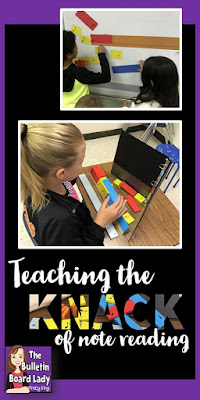
Learn a fun manipulative for teaching rhythm called Note Knacks.  Use them as a whole class visual aid, in small groups or workstations.  So much fun!

I am always on the look out for manipulatives that keep students engaged.  If you are a regular reader of my blog you know that I am also found of manipulatives that work well as part of workstation rotations.  In this blog post I am going to talk about the awesome blocks called Note Knacks.  (This is not a sponsored post, I just LOVE these!)
Learn a fun manipulative for teaching rhythm called Note Knacks.  Use them as a whole class visual aid, in small groups or workstations.  So much fun!

Note Knacks are wooden blocks that are strategically cut so that note value is represented by block length.  So a half note is half the size of a whole note and a quarter note is half the size of a half note and so on.  The set comes with 3 different frames to hold the Note Knacks.  They measure 4 beats, 3 beats and 2 beats.  One side of the block has a note and the back side has the corresponding rest.  
Learn a fun manipulative for teaching rhythm called Note Knacks.  Use them as a whole class visual aid, in small groups or workstations.  So much fun!

I am lucky enough to have a magnetic set of Note Knacks and I keep them on my dry erase board.  They are much larger so that they can be seen by an entire classroom.  I've used them to decipher rhythms in familiar songs and to create ostinatos for various activities.  I've also used them in workstations.

Learn a fun manipulative for teaching rhythm called Note Knacks.  Use them as a whole class visual aid, in small groups or workstations.  So much fun!

For the workstation, I had one student sit at a desk with the wooden blocks.  We put up an empty notebook to create a privacy screen.  The student at the desk composes a rhythm and then claps it for the rest of the group.  The other group members re-create the rhythm using the magnetic blocks on the board.  Students LOVED using the blocks.

I must admit that I like using them too!  There is something lovely about they way they feel and being a visual learning, I totally dig the visual representation of duration.
Learn a fun manipulative for teaching rhythm called Note Knacks.  Use them as a whole class visual aid, in small groups or workstations.  So much fun!
I've also had students trace the outline of the blocks on long strips of bulletin board paper.  I only have one set of the blocks, so I could only do this activity with small groups as they rotated through workstations.  I hope to get a few more sets because I have SO many ideas I want to try out!

I bet I know what you are thinking.  Couldn't you just make something similar?  Well, sure.  I've made Noodle Notes which are similar.  The tactile experience of Note Knacks is what I like.  I mean, who doesn't like playing with blocks?

You can get Note Knacks from Rhythm Band Instruments.  If you liked these ideas PIN this post for later!
Learn a fun manipulative for teaching rhythm called Note Knacks.  Use them as a whole class visual aid, in small groups or workstations.  So much fun!

post signature

Fidget Spinners in Music Class

Fidget spinners can be a useful and exciting manipulative for music class.  Your students can use them as regular spinners or as timers to practice their musical knowledge assessment.  Wow your administrator with fidget spinning assessment!  Music teacher WIN!

There seems to be a great debate among parents and educators about the value of fidget spinners in the classroom.  This blog post is NOT about that.  Instead, I'd like to share with you a few ways that you can use the spinners for practice and assessment in music class.

I've created a set of activities that use the fidget spinner as a timer and as...well...just as a spinner!  The best way to show you how to use them is in this video below.


You can find the Music Fidget Spinner Fun set HERE.  Enjoy!

Fidget spinners can be a useful and exciting manipulative for music class.  Your students can use them as regular spinners or as timers to practice their musical knowledge assessment.  Wow your administrator with fidget spinning assessment!  Music teacher WIN!


post signature

Music Lesson Ideas for Quiet Days

Music lesson plans for days when you need to be as quiet as possible.  These quiet activities include ways to teach pitch, rhythm, composers and more in a quiet music classroom.

"You want me to teach music QUIETLY?" I said in disbelief.  "Is that even possible?"

It was testing season and I was fortunate to have my schedule only moderately rearranged.  The problem?  I had to teach music as quietly as possible.  I laugh thinking about how dumbfounded I was at the very idea.  Now with quite a few testing seasons under my belt I have a few suggestions for how to teach musical lesson in quiet ways.  Read on, but shhhh! Let's keep it down.

Pitch

Music lesson plans for days when you need to be as quiet as possible.  These quiet activities include ways to teach pitch, rhythm, composers and more in a quiet music classroom.
One of my favorite quiet activities for teaching pitch is to use my bottle cap staff sheets.  I have them laminated and use them for a variety of lesson.  For this lesson I pass out the sheets and a hand full of bottle caps.  I will say a word that can be spelled on the staff and students "write" it by putting their bottle caps in order.  In the picture, we just spelled "cafe".
Although the staff sheets are easy enough to make, I have a whole set of the staves and word cards in my store that you maybe interested in:  Bottle Cap Staff

 Rhythm

Music lesson plans for days when you need to be as quiet as possible.  These quiet activities include ways to teach pitch, rhythm, composers and more in a quiet music classroom.
 There are many ways to work on rhythm quietly.  Consider using chopsticks instead of rhythm sticks to play on the back of chairs or even on the floor.  The sound is light and intriguing for even 6th graders.
Another great quiet drumming activity (I know...quiet drumming?) is to use drum sticks on  foam garden kneeling pads.  I found purple and blue ones at Dollar Tree and LOVE that kids can really beat on them, but they sound delightfully muted.  :-)
Music lesson plans for days when you need to be as quiet as possible.  These quiet activities include ways to teach pitch, rhythm, composers and more in a quiet music classroom.

Rhythmic dictation is a pretty quiet activity too.  I use dry erase boards or lap packs (staff paper or blank paper stuffed into a page protector) and dry erase markers.  You might consider using craft sticks, rhythm cards, mini erasers (matching the syllables in the name of the eraser to the number of sounds in the rhythm) and more.  Clap or tap the rhythms on an instrument, students echo and then write it down.  It is a great assessment and requires great listening skills.

Instead of writing the rhythms down, you might consider having students listen to the rhythm that you play and then circling the correct notation from a few examples.  I have an entire set of "What Do You Hear" worksheets that ask students to do just that.  They vary in complexity so you can use the set with multiple grade levels.  Click HERE to learn more.
Music lesson plans for days when you need to be as quiet as possible.  These quiet activities include ways to teach pitch, rhythm, composers and more in a quiet music classroom.

 Composer Studies

Music lesson plans for days when you need to be as quiet as possible.  These quiet activities include ways to teach pitch, rhythm, composers and more in a quiet music classroom.
If you are able to show videos, I highly recommend the Composer Series of movies about the lives of famous composers.  (not an affiliate link)  You probably already have these in your classroom.  

In addition to showing composer videos, you might consider planning time for your students to just listen to, read about and color pictures of popular composers.  I've talked about this kind of thing in a previous blog post: Coloring Composers.  You can get the set that I use HERE.

I also LOVE Jena Hudson's composer flip books.  You can find them in her store, Sew Much Music on TpT, or follow this link to try the American Composers Set for free!  

 Listening

Music lesson plans for days when you need to be as quiet as possible.  These quiet activities include ways to teach pitch, rhythm, composers and more in a quiet music classroom.

Another quiet, creative activity is listening and responding.  Choose a piece of music that inspires a story or vivid mental images.  Have students listen the first time.  For wiggly classes you may want to have them lightly tap the beat or follow you as you tap the beat in various ways.  
Next, have students lie down (if possible), close their eyes and imagine what kind of story the composer wanted them to "see" in the music.
Pass out blank pieces of paper and have them illustrate what they have heard.  For K-2, I often use THIS set of writing prompts that already have a few words written and blank writing lines.

A few of my favorite pieces to use are:
"Moonlight Sonata" by Beethoven (Be prepared!  This one sometimes brings pictures of pets that have passed away!)
"Bugler's Holiday" by Anderson
"Stars and Stripes Forever" by Sousa (Shh! You might want to turn this one down a little!)
"Ballet of the Unhatched Chicks" by Mussorgsky
"Funeral March of a Marionette" by Gounod
"Minute Waltz" by Chopin
"Hungarian Dance No. 5" by Brahms

 Instruments of the Orchestra


If you are able to show videos, I highly recommend the Instrumental Classmates set of videos to introduce the instrument families.  I found my set on Amazon.  Quaver also has a great series of videos about instruments that your students will enjoy.  

If you are unable to show a video, your students might enjoy putting together a book of instruments.  Students can color the instruments, copy their name or add information about the instrument (with the add-on sheets included).  Click the picture above to get the full set of instrument families or click HERE to get the sampler for free.  Although this takes some time to make all of the copies you'll need, it is a great activity for a quiet day in music.

Another great quiet day activity is to read the book "The Remarkable Farkle McBride".  My 5th graders enjoy this story, so I can use this lesson with all of my classes.  At the end of the story, we will review instrument families and I'll pass out these simple coloring sheets.  While students are coloring we will listen to my classical music playlist for some quiet background music.

 Quiet Games

Music lesson plans for days when you need to be as quiet as possible.  These quiet activities include ways to teach pitch, rhythm, composers and more in a quiet music classroom.
Quiet games are not usually favorites in my classroom, but over the years I've come up with a few that students will give a reluctant thumbs up.  They would much rather be drumming and dancing and singing, but quiet days don't always allow for that.

Telephone - This traditional game is played by having students sit in a circle and whispering a message to each other until it makes it all the way around the circle.  Hilarity ensues when the message at the end sounds nothing like the message that started.  The same idea can work with rhythms.  Have students tap a 4 beat measure on the back of the person next to them and then pass that around the group.  Students can usually master this in a couple of tries so then we make it a bit more difficult.  Instead of sending one rhythm around in one direction, start two rhythms.  One goes to the left and the other to the right and they all end up back at the same person.  Tricky!

Roll and Cover is a game for small groups.  Students take turns rolling the dice.  The key on each page says a note or rest name.  Students then find that symbol in the picture and color one piece of the picture.  Taking turns, play goes around the circle until someone has every piece colored.  It is a nice way to review notes and clefs.  You can find Roll and Cover sets in my store.  Any normal die will work, but I always try to get the large foam dice to use because they are so much more fun!

I hope that you are never asked to teach music quietly, but if you are I hope that some of these ideas will prove helpful.  Like these ideas?  PIN THEM for later.

Music lesson plans for days when you need to be as quiet as possible.  These quiet activities include ways to teach pitch, rhythm, composers and more in a quiet music classroom. 


post signature

A Handy Way to Teach Treble Clef Names

Teach the treble clef lines and spaces with this "handy" trick that involves gloves!  Students leave with a crafty project that helps them read treble clef pitches!

You've probably heard of using your hand as a visual aid for learning the names of pitches on the treble clef staff.  With five fingers....err...four and your thumb to represent lines and 4 spaces, it is perfect!  I wanted to take that idea just a little bit further with my students.  This is what we did.

Teach the treble clef lines and spaces with this "handy" trick that involves gloves!  Students leave with a crafty project that helps them read treble clef pitches!
Using plastic gloves and permanent markers we wrote the names of the lines at the tips of our fingers.  To solidify the concept that our fingers represented the treble clef lines, we drew lines on our fingers too.  Some of my students claimed they were drawing their bones!  

Next we found the spaces between our fingers and labeled them with the treble clef space names. 

Teach the treble clef lines and spaces with this "handy" trick that involves gloves!  Students leave with a crafty project that helps them read treble clef pitches!

With my students this year I used very thin, clear gloves that you might see food service workers use in your cafeteria.  They were pretty inexpensive but were quite large for some of my smaller students.  They were a safe choice for students with an allergy to latex.

Another time I used latex gloves (pictured above).  These gloves allowed us to write more clearly, but were MUCH more expensive.  I bought a box of large and a box of small and they fit better than the plastic gloves.  I would only recommend these if you were working with a pretty small class or were able to secure donations.

Teach the treble clef lines and spaces with this "handy" trick that involves gloves!  Students leave with a crafty project that helps them read treble clef pitches!
Permanent markers dried pretty fast during this project.  I experimented with several other writing utensils include ink pens, flair pens and paint pens.  Permanent markers are definitely the way to go.

After we finished our gloves we practiced using them with Music K-8's songs "Every Good Boy Does Fine" and "FACE" on YouTube.   I also love Quaver Music's "Lines and Spaces" for this activity.

Like this idea?  PIN IT for later!
Teach the treble clef lines and spaces with this "handy" trick that involves gloves!  Students leave with a crafty project that helps them read treble clef pitches!


post signature

Flashlight Routines that Teach Form

Flashlight routines in music class can be used to reinforce form and keep students engaged and excited about learning.  This post shares routines for "Cantina Band" by John Williams and "March" from the Nutcracker as well as tips and tricks for using them successfully in your music classroom.

The first time I experienced using flashlights to demonstrate musical form was in a workshop by the talented and genius, Artie Almeida.  I love using them to keep students engaged and my students love them for their novelty.
Flashlight routines in music class can be used to reinforce form and keep students engaged and excited about learning.  This post shares routines for "Cantina Band" by John Williams and "March" from the Nutcracker as well as tips and tricks for using them successfully in your music classroom.
For most flashlight routines that I have used in class I use two or three colors.  I use a large permanent marker and color in the lens. Depending on the marker, you may want to let it dry and then color it again.
Instead of using permanent markers, you could use colored plastic wrap and rubber bands.  I didn't like how often my rubber bands disappeared and turned into weapons, so after a time or two I decided this was not a good choice for me.

Flashlight routines in music class can be used to reinforce form and keep students engaged and excited about learning.  This post shares routines for "Cantina Band" by John Williams and "March" from the Nutcracker as well as tips and tricks for using them successfully in your music classroom.
Flashlights
I chose inexpensive flashlights from the dollar store about bought about 10 more than my largest class because I expected some of them to break easily.  The batteries were pretty expensive, but with the help of a regional grant I was able to get enough to fill every flashlight.  

When using the flashlights sitting down, you get a large light on the ceiling.  It's pretty, but not very distinct or clear if your room isn't completely dark.  In the picture above you can see what it looks like when students are sitting.  In the picture below students were standing.  That produced a smaller, cleaner look to their light and it looked much better when we were all working together.

You could always buy smaller flashlights with a stronger beam to get the same effect.

Flashlight routines in music class can be used to reinforce form and keep students engaged and excited about learning.  This post shares routines for "Cantina Band" by John Williams and "March" from the Nutcracker as well as tips and tricks for using them successfully in your music classroom.

Teaching Form
Before putting flashlights in their hands we listen to the piece of music.  We either follow a listening maps or we listen and create our own listening map.  This gives students the experience they need to be successful when they get the flashlights.

We label each section with a letter name and decide on an action for the flashlight.

Flashlight routines in music class can be used to reinforce form and keep students engaged and excited about learning.  This post shares routines for "Cantina Band" by John Williams and "March" from the Nutcracker as well as tips and tricks for using them successfully in your music classroom.

Flashlight routines in music class can be used to reinforce form and keep students engaged and excited about learning.  This post shares routines for "Cantina Band" by John Williams and "March" from the Nutcracker as well as tips and tricks for using them successfully in your music classroom.

This video is of one of my 5th grade classes and their first attempt at a flashlight routine to "Cantina Band".  This is an unedited, imperfect, completely authentic look at how this works in my classroom.  I love how at section D they are in awe of their own awesomeness!


Flashlight routines in music class can be used to reinforce form and keep students engaged and excited about learning.  This post shares routines for "Cantina Band" by John Williams and "March" from the Nutcracker as well as tips and tricks for using them successfully in your music classroom.

I hope this inspires you to try using flashlights in your classroom.  Do you have any favorite pieces that would work well with flashlights?  I would love to learn about them.  Let me know in the comments.

Flashlight routines in music class can be used to reinforce form and keep students engaged and excited about learning.  This post shares routines for "Cantina Band" by John Williams and "March" from the Nutcracker as well as tips and tricks for using them successfully in your music classroom.


post signature

Note Value Bowling Music Workstation

Note Value Bowling is a fun music workstation that reinforces note values and causes lots of smile!  Use a toy bowling set and the free Note Value Bowling score sheets to bowl your students over to reading music!

Bowling in music class?  You bet! It may be your students' favorite music workstation!  Read on to find out how to create the fun and functional workstation for your classroom.

Note Value Bowling is a fun music workstation that reinforces note values and causes lots of smile!  Use a toy bowling set and the free Note Value Bowling score sheets to bowl your students over to reading music!

I have several sets of bowling pins at my house.  I know that sounds weird, but I've been working on and then perfecting a bowling workstation for several years.  The set that I used in the pictures is a wooden set.  It is a nice size and weight and the pins make a lovely sound when they fall down.

This set was on sale for 75% off when I picked it up.  Music teacher WIN!  I've picked up some at discount stores and yard sales too.

From experience with Layton Music's Music Yahtzee, I knew that putting a single eighth not or a dotted quarter note would up the difficulty of this game to the point where not all of my students would be able to play and successfully record their score.  I decided to use notes that would not utilize fractions, or their mathematical brothers, decimals.  I used quarter note, barred eighth notes, 4 sixteenth notes, half note, dotted half note and whole note.  I drew one of these on each of the six pins.  I used a permanent marker, but you could also use a paint pen.

Note Value Bowling is a fun music workstation that reinforces note values and causes lots of smile!  Use a toy bowling set and the free Note Value Bowling score sheets to bowl your students over to reading music!

I have a plastic set of pins.  I used a white paint pen and a silver Sharpie to draw on the notes.  They have held up quite well.  Although you could store the pins in their original box or container, I haven't found a set that holds up well.  I buy plastic storage containers and place everything in them.
Note Value Bowling is a fun music workstation that reinforces note values and causes lots of smile!  Use a toy bowling set and the free Note Value Bowling score sheets to bowl your students over to reading music!

Before introducing the game to students I spent some time practicing.  (Turns out I'm a pathetic bowler!)  I experimented with how far apart to place the pins and how far back I needed to stand to roll the boll.  If the pins are too far apart, they won't all fall down even with a perfect throw.  If they are too close together, they will all fall down every time.  I ended up finding the perfect distance for my set of pins and marking their placement with a piece of masking tape,  I also drew the note on the masking tape to help them set up as quickly as possible.

After much experimentation, I decided that my students needed to stand 4 floor tiles away from the pins.  (That's somewhere between 4 and 5 feet.)

If you don't have a bowling set, you can create your own pins with 20 ounce soda or water bottles.  You could even use empty 2-liter bottles.  Spray paint them before drawing the notes on and add about a third of a bottle of beans or sand to steady them.  Small Nerf balls would work great with these DIY pins. 
Note Value Bowling is a fun music workstation that reinforces note values and causes lots of smile!  Use a toy bowling set and the free Note Value Bowling score sheets to bowl your students over to reading music!

To complete the workstation, I include a score sheet on a clipboard and a pencil.  One version of the score sheet contains a "cheat sheet" and shows students the note value of each pin.  The other version does not.  My goal in using this workstation is to reinforce note values, so I don't mind if students use the score sheet with the references.  They still gain practice in adding them all together.

Note Value Bowling is a fun music workstation that reinforces note values and causes lots of smile!  Use a toy bowling set and the free Note Value Bowling score sheets to bowl your students over to reading music!
You can download both of the sheets by clicking on the picture above or by clicking HERE.  I hope that your students enjoy this activity!

Note Value Bowling is a fun music workstation that reinforces note values and causes lots of smile!  Use a toy bowling set and the free Note Value Bowling score sheets to bowl your students over to reading music!


post signature

Books You Need in Your Music Classroom - Upper Elementary List


Picture books and chapter books for the music classroom are essentials.  Explore this list of books appropriate for upper elementary that cover instruments, composers, careers, history and more.
I love incorporating books into my music lessons and I am adamant that I have a classroom library of books that teach about music history, explore music genres and dance, serve as a reference and more.  This year I moved to a new classroom that had NO music classroom library.  None.  Zilch.  Since I use a reading station in almost of my workstation rotations, I new I had to do something.

I have my own library of books that I've purchased during the last 20 years, so I had a few things to start with but soon realized most of my books were for primary aged students.  I'm currently teaching 3rd, 4th and 5th graders and most of the books that I had were for Kindergarten through 2nd grades.

Off to Amazon I went!  I would love to say that I researched for hours and consulted a stack of teacher resources, but I already had a wishlist a mile long for this age group!   Below you'll find a list of the books I have in my library that are appropriate for upper elementary classes.  

This list is not even CLOSE to being comprehensive.  There are hundreds of books that I could add to this list and more being published every year.  This list may be a good starting point for you if you are building a library for your music classroom.
Picture books and chapter books for the music classroom are essentials.  Explore this list of books appropriate for upper elementary that cover instruments, composers, careers, history and more.
Charlie Parker Played Be Bop      Chris Raschka
Leaf Man             Lois Ehlert
Max Found Two Sticks   Brian Pinkney
Thump Thump Rat-a-Tat-Tat       Gene Baer
Abiyoyo               Pete Seeger, illus by Michael Hays
The Music Teacher from the Black Lagoon            Mike Thaler
We All Went on Safari:  A Counting Journey through Tanzania     Laurie Krebs and Julia Cairns
Chalk     Bill Thomson  (This book is GREAT for introducing opera.  Students sing an improvised story to this book.)
M is for Music    Kathleen Krull

Dance
Dictionary of Dance         Liz Murphy
My Many Colored Days   Dr. Suess
The Story of the Nutcracker Ballet   Deborah Hautzig

Sing the Book
America the Beautiful    Scholastic

Blowin' in the Wind         Bob Dylan, illus John J. Muth
Don't Laugh at Me           Steve Seskin and Allen Shamblin
Froggie Went a-Courtin'                Iza Trapani
Grandma's Feather Bed     Christopher Canyon (lyrics by John Denver)
Puff the Magic Dragon      Peter Yarrow, Lenny Lipton
Senor Don Gato     illustrated by John Manders
Take Me Home, Country Roads     Christopher Canyon (lyrics by John Denver)
Take Me Out of the Bathtub and Other Silly Dilly Songs  Alan Katz
There Was a Cold Lady Who Swallowed Some Snow        Lucille Colandro
There was an Old Lady Who Swallowed a Bat      Lucille Colandro
There was an Old Lady Who Swallowed a Bell     Lucille Colandro
There was an Old Lady Who Swallowed a Fly       Simms Taback
There Was an Old Lady Who Swallowed a Shell  Lucille Colandro
What a Wonderful World             Tip Hopbood
Possum Come a-Knockin'             Nancy Van Laan

Picture books and chapter books for the music classroom are essentials.  Explore this list of books appropriate for upper elementary that cover instruments, composers, careers, history and more.
 Biography and Careers in Music
Some of these books are chapter books, so students may only get to read a portion of the book during workstation rotations.  My room is used as a bus room and so students also have the opportunity to read during bus room.  I do not lend my books out, but if something is quite popular I let our school librarian know.
Who Is Dolly Parton?      True Kelley
Who Was Elvis Presley? Geoff Edgers
Who was Michael Jackson? Megan Stine
Who Were the Beatles?  Geoff Edgers
There are more titles in this series that you might like.  Elton John and Bruce Springsteen are a few more musicians you can find.
Picture books and chapter books for the music classroom are essentials.  Explore this list of books appropriate for upper elementary that cover instruments, composers, careers, history and more.
Marvin Makes Music      Jim Madsen
When the Beat was Born:  DJ Kool Herc and the Creation of Hip Hop        Laban Carrick Hill
 
Picture books and chapter books for the music classroom are essentials.  Explore this list of books appropriate for upper elementary that cover instruments, composers, careers, history and more.
Composers
Aaron Copland (Getting to Know the World's Greatest Composers)         Mike Venezia
Duke Ellington (Getting to Know the World's Greatest Composers)          Mike Venezia
George Gershwin (Getting to Know the World's Greatest Composers)   Mike Venezia
George Handel (Getting to Know the World's Greatest Composers)        Mike Venezia
I, Vivaldi               Janice Shefelman
Johann Sebastian Bach (Getting to Know the World's Greatest Composers)         Mike Venezia
John Philip Sousa (Getting to Know the World's Greatest Composers)    Mike Venezia
Ludwig van Beethoven (Getting to Know the World's Greatest Composers)         Mike Venezia
Wolfgang Amadeus Mozart         Mike Venezia
Young Mozart    Rachel Isadora
Famous Composers Reference Book      Usborne

Picture books and chapter books for the music classroom are essentials.  Explore this list of books appropriate for upper elementary that cover instruments, composers, careers, history and more.
Patriotic
I teach a "Star-Spangled Banner" unit and like to have a few books on hand for students who finish early.  These are a couple of my favorites.
By the Dawn's Early Light, The Story of the Star-Spangled Banner    Steven Kroll
Can You Sing "The Star-Spangled Banner"?          Martha E.H. Rustad

History
Do Re Mi:  If You Can Read This Thank Guido A'rezzo       Susan Roth
Everyday History: Song and Dance           John Malam
The Rock and Roll Alphabet         Jeffrey Schwartz
V is for von Trapp:  A Musical Family Alphabet    William Anderson
We Shall Overcome:  The Story of a Song              Debbie Levy
When Marian Sang          Pam Munoz Ryan
Before John Was a Giant              Carole Boston Weatherford
John Henry         Julius Lester, illus Jerry Pinkney

Instruments
I Know a Shy Fellow Who Swallowed a Cello        Barabara S. Garriel
Lemony Snicket The Composer is Dead  Nathaniel Stookey
M is for Melody                Kathy-jo Wargin
Never Play Music Right Next to the Zoo John Lithgow
The Remarkable Farkle McBride       John Lithgow
Zin! Zin! Zin! A Violin       Lloyd Moss
Moses Goes to a Concert             Isaac Millman

Getting Your Library Ready
Picture books and chapter books for the music classroom are essentials.  Explore this list of books appropriate for upper elementary that cover instruments, composers, careers, history and more.

Every teacher has to find what works best for them, but here are some things that I do to keep my classroom library in good shape:
1.  I put my name on the inside of the front cover, on the back cover and inside the book.  I use a permanent marker and a paint pen on books with a dark cover.
2.  Some of the books have CDs inside of them.  I prefer to keep the CDs in the book, so I tape them in and write "Do not remove." in permanent marker in an obvious place.  I must admit that this works great for every class except Kindergarten.  *giggle*  They rip the CD out and bring it to me so it doesn't get broken.  
3.  I usually keep my library on a shelf, but you could use milk crates, a rolling cart or even a book bag if you were only going to use them during workstations.

I hope that this list is helpful and would love to hear other suggestions for books to add to my library.  Leave the title of your favorites for upper elementary classes in the comments.  If you liked these ideas, pin this post for later!
Picture books and chapter books for the music classroom are essentials.  Explore this list of books appropriate for upper elementary that cover instruments, composers, careers, history and more.

post signature